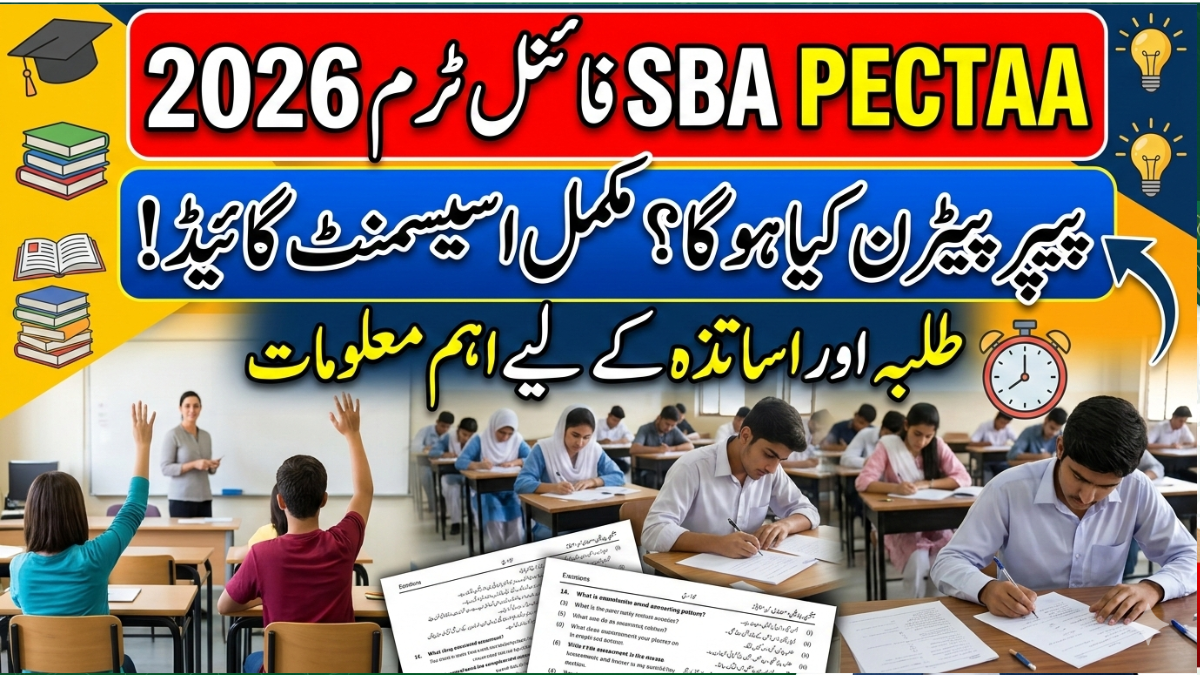
The PECTAA Final Term School Based Assessment (SBA) 2026 is an important evaluation system introduced to measure students’ academic progress in a more practical and transparent way. In recent years, the education system has started moving away from traditional exam-only methods toward modern assessment strategies that focus on conceptual learning, analytical thinking, and classroom participation.
The School Based Assessment (SBA) system allows teachers to evaluate students continuously through activities like quizzes, assignments, classroom discussions, and written tests. This approach ensures that students are assessed not only on memorization but also on their understanding and practical knowledge.
In 2026, the PECTAA assessment system is expected to become even more structured and organized, making it easier for both teachers and students to follow the evaluation process.
What is PECTAA School Based Assessment 2026?
The School Based Assessment (SBA) is a modern evaluation method where students are assessed within the school environment. Instead of depending only on final exams, teachers evaluate students through different academic activities during the academic year.
The PECTAA Final Term Assessment 2026 is the final evaluation stage of this system. It measures how well students have understood their syllabus and how effectively they have performed in different classroom activities.
This system also helps teachers identify the strengths and weaknesses of students, allowing them to guide students for better academic improvement.
PECTAA SBA Final Term Paper 2026 – Key Information
| Assessment Detail | Information |
|---|---|
| Assessment Name | PECTAA Final Term School Based Assessment |
| Year | 2026 |
| Assessment Type | School Based Evaluation (SBA) |
| Conducted By | School Teachers under Education Authority Guidelines |
| Purpose | To evaluate students’ academic progress and understanding |
| Subjects Included | English, Urdu, Mathematics, Science, Islamiat, Social Studies |
| Assessment Methods | Written Tests, Assignments, Classroom Activities |
| Target Students | Primary and Middle School Students |
| Result Basis | Overall classroom performance and test results |
Objectives of PECTAA Final Term SBA 2026
The main goal of the PECTAA School Based Assessment 2026 is to improve the quality of education and enhance students’ learning outcomes.
Key objectives include:
-
Encouraging conceptual learning instead of rote memorization
-
Monitoring student progress regularly
-
Improving teaching methods in classrooms
-
Promoting active student participation
-
Developing analytical and problem-solving skills
-
Providing fair and transparent evaluation
This system ensures that every student receives proper attention and continuous assessment throughout the academic year.
Structure of PECTAA Final Term School Based Assessment 2026
The Final Term SBA 2026 includes multiple components to evaluate students in a balanced way.
1. Written Tests
Students attempt subject-based written tests to measure their understanding of the syllabus.
2. Classroom Activities
Participation in class discussions, group projects, and activities also contributes to the assessment.
3. Assignments
Students complete assignments related to their subjects to demonstrate their understanding.
4. Oral Assessment
Teachers may ask questions orally to test comprehension and speaking ability.
5. Practical Activities
Some subjects may include practical demonstrations or activity-based tasks.
Subjects Included in SBA 2026
The PECTAA Final Term School Based Assessment covers major subjects taught in primary and middle schools.
These subjects include:
-
English
-
Urdu
-
Mathematics
-
Science
-
Islamiat
-
Social Studies
-
Computer Studies
Each subject is assessed according to the approved syllabus for the academic year.
SBA 2026 Grade 5 Final Term Date Sheet
| Date | Day | Grade 5 Subject |
|---|---|---|
| 10 March 2026 | Monday | Islamiat / Ethics |
| 12 March 2026 | Wednesday | English |
| 13 March 2026 | Thursday | Tarjuma-tul-Quran |
| 14 March 2026 | Friday | Nazra Quran |
| 17 March 2026 | Monday | Tarjuma-tul-Quran |
| 18 March 2026 | Tuesday | Islamiat / Ethics |
| 21 March 2026 | Friday | General Knowledge / Science |
School Based Assessment 2026 Grade 5 – Subject Details
English – Grade 5 SBA Final Term
The English paper generally includes:
-
Reading comprehension
-
Grammar exercises
-
Vocabulary
-
Paragraph or short essay writing
-
Translation (if applicable)
Paper Pattern
-
MCQs
-
Short questions
-
Long questions
Urdu – Grade 5 SBA Final Term
The Urdu paper covers:
-
Nazam and prose explanation
-
Grammar rules
-
Mazmoon writing
-
Translation
-
Comprehension
Mathematics – Grade 5 SBA Final Term
Topics usually include:
-
Fractions and decimals
-
Word problems
-
Basic geometry
-
Multiplication and division
-
Problem solving
General Science – Grade 5 SBA Final Term
Important topics include:
-
Human body
-
Environment
-
Plants and animals
-
Basic physics and science concepts
Social Studies – Grade 5 SBA Final Term
Students study topics such as:
-
Pakistan Studies basics
-
Geography concepts
-
Civics
-
History topics
Islamiat / Ethics – Grade 5 SBA Final Term
The paper includes:
-
Basic Islamic teachings
-
Short questions
-
Moral lessons
-
Important duas
Nazra Quran – Grade 5 SBA Final Term
Assessment includes:
-
Oral recitation
-
Tajweed basics
-
Quran reading evaluation
Nazra Quran assessment is usually 50 marks.
SBA 2026 Grade 6 Final Term Date Sheet
| Date | Day | Grade 6 Subject |
|---|---|---|
| 10 March 2026 | Monday | Mathematics |
| 12 March 2026 | Wednesday | Urdu |
| 13 March 2026 | Thursday | English |
| 14 March 2026 | Friday | Computer / Arabic |
| 17 March 2026 | Monday | History & Geography |
| 18 March 2026 | Tuesday | Social Studies |
| 19 March 2026 | Wednesday | History & Geography |
| 21 March 2026 | Friday | Science |
School Based Assessment 2026 Grade 6 – Subject Details
English – Grade 6 SBA Final Term
The English paper includes:
-
Reading comprehension
-
Grammar exercises
-
Essay writing
-
Letter or application writing
-
Translation
The exam checks both writing skills and grammar understanding.
Urdu – Grade 6 SBA Final Term
The Urdu paper covers:
-
Tashreeh (lesson explanation)
-
Grammar rules
-
Mazmoon writing
-
Translation
-
Comprehension
Students are expected to write clear and well-structured answers.
Mathematics – Grade 6 SBA Final Term
Important topics include:
-
Algebra basics
-
Fractions and decimals
-
Ratio and proportion
-
Geometry
-
Percentages
-
Word problems
Logical thinking and problem-solving ability are important in this subject.
General Science – Grade 6 SBA Final Term
Science topics include:
-
Basic physics concepts
-
Introduction to chemistry
-
Biology fundamentals
-
Diagrams and definitions
-
Scientific reasoning
Students should focus on understanding concepts rather than memorizing them.
Social Studies – Grade 6 SBA Final Term
The Social Studies paper includes:
-
History basics
-
Geography concepts
-
Civics
-
Pakistan Studies
Understanding maps, historical events, and key concepts is important.
Islamiat / Ethics – Grade 6 SBA Final Term
Topics include:
-
Islamic teachings
-
Short questions
-
Moral lessons
-
Quranic concepts
Students should revise key lessons from their textbooks.
Computer Education – Grade 6 SBA Final Term
The computer paper covers:
-
MS Office basics
-
Hardware and software
-
Internet concepts
-
Basic computer operations
Practical knowledge of computer basics is important.
Tarjuma-Tul-Quran – Grade 6 SBA Final Term
This subject includes:
-
Translation of selected Surahs
-
Basic explanation
-
Short questions
SBA 2026 Paper Pattern – Grade 6
The Final Term SBA paper format usually includes:
-
Multiple Choice Questions (MCQs)
-
Short Answer Questions
-
Long Answer Questions
-
Fill in the blanks
-
True / False
-
Matching columns
Total Marks
-
100 marks for most subjects
-
50 marks for Quran-related subjects
Final Thoughts
The PECTAA Final Term School Based Assessment 2026 is an important step toward improving the education system. By focusing on conceptual learning, classroom activities, and continuous evaluation, the SBA system helps students develop stronger academic skills.
Instead of relying only on traditional exams, this modern assessment method encourages students to think critically, participate actively, and understand their subjects deeply.
For students, the best preparation strategy is to revise textbooks, practice past questions, complete assignments carefully, and stay active in classroom learning activities.